Strong Confidence in AI Safety Priorities Remains Limited: 16% Have ‘A Great Deal,’ AGI Poll Reveals
A survey of 100 Americans finds that confidence in AI companies is split almost evenly, while strong confidence remains rare. The clearest public demand is for outside oversight before any company claims that an advanced system is safe enough to release.
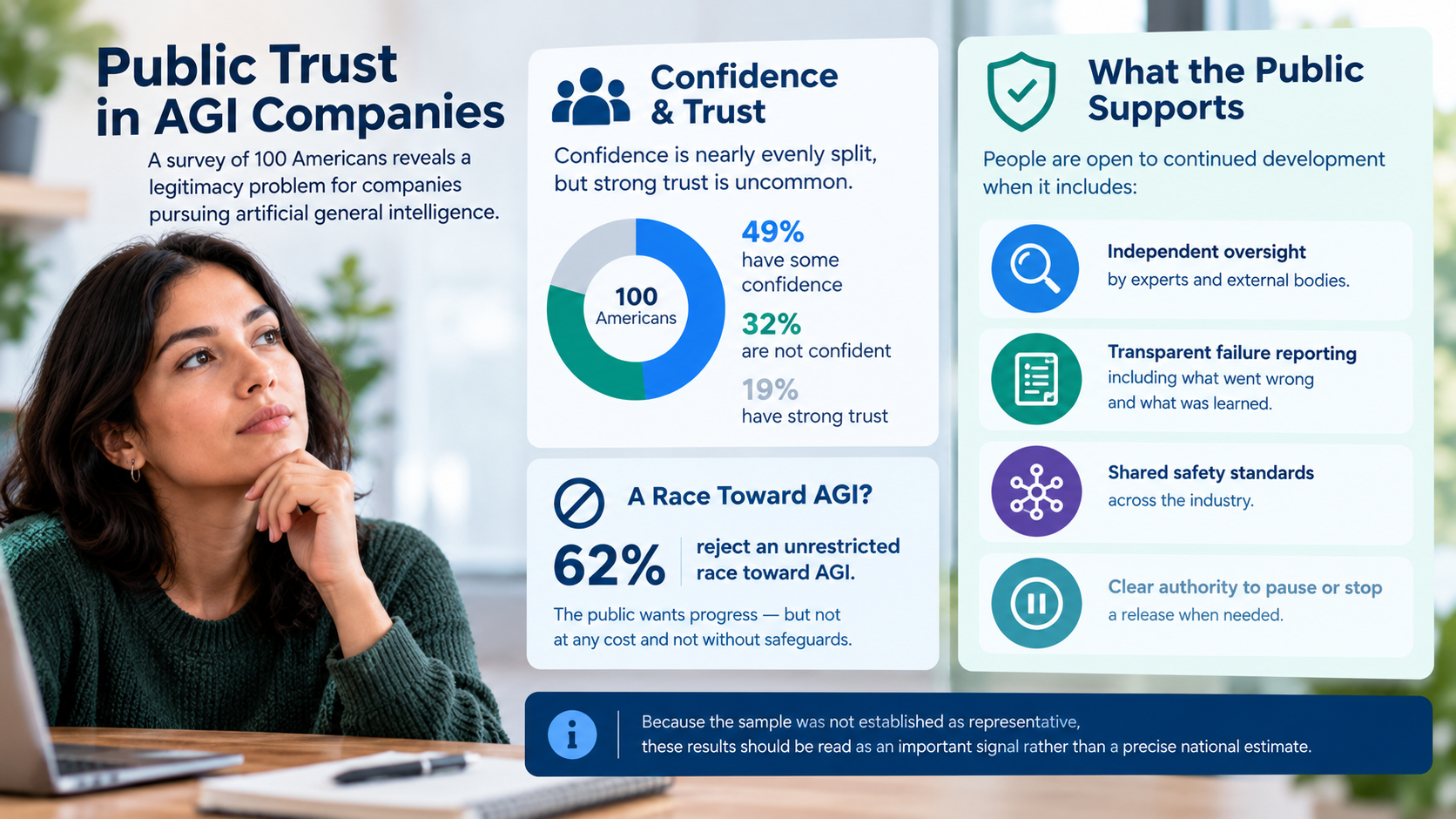
The results point to a serious legitimacy problem for the companies pursuing artificial general intelligence, or AGI. Only 15.6% of respondents said they had ‘a great deal’ of confidence that leading AI companies would put public safety ahead of the race to develop AGI first. Another 34.2% expressed ‘a fair amount’ of confidence, bringing the combined total to 49.8%.
The skeptical side was slightly larger. A total of 50.2% said they had ‘not too much’ confidence or ‘none at all.’ The gap is narrow, but the intensity of the responses matters. One in five respondents had no confidence whatsoever, while fewer than one in six expressed the strongest level of trust.
That imbalance helps explain the survey’s broader findings. Nearly nine in ten respondents rejected an unrestricted race toward AGI. Most supported slowing development, adding independent safety oversight, or stopping development entirely. The public appears willing to accept continued progress when companies accept enforceable limits around it.
The headline number is a warning
The 15.6% figure measures more than general unease about new technology. It speaks directly to whether AI companies can be trusted with decisions that could affect the public at a large scale.
The survey asked whether leading companies would put public safety ahead of the effort to be first to develop AGI. The answers were almost evenly divided:
- 15.6% had a great deal of confidence.
- 34.2% had a fair amount of confidence.
- 30.0% had not too much confidence.
- 20.2% had no confidence at all.
The combined result gives companies a narrow opening. Nearly half of respondents still see some reason to believe that safety could take priority. The figures also show how difficult it would be for companies to claim broad public support for a fast, self-directed development race.
A company can interpret 49.8% as evidence that trust remains available. It can also read the same number as a warning that half of the public expects competitive pressure to overwhelm safety commitments. Both interpretations fit the data. The second one carries greater practical weight because distrust is concentrated among respondents who favor strong restrictions.
Among respondents with more confidence in AI companies, 53.1% still wanted stronger independent oversight. Only 16% supported developing AGI as quickly as possible. Trust, in other words, did not create enthusiasm for a winner-take-all race. It created a somewhat greater willingness to continue under conditions.
Synopsis
A survey of 100 Americans reveals a legitimacy problem for companies pursuing artificial general intelligence. Confidence is nearly evenly split, but strong trust is uncommon, and most respondents reject an unrestricted race toward AGI. The public remains open to continued development when it includes independent oversight, transparent failure reporting, shared safety standards, and clear authority to pause or stop a release. Because the sample was not established as representative, the results should be read as an important signal rather than a precise national estimate.
A capability lead does not settle legitimacy
The survey found a sharp gap between perceived technical leadership and responsible stewardship, especially for OpenAI. Respondents were most likely to name OpenAI as the company that would develop AGI first, with 31.7% choosing it. Only 11.4% trusted OpenAI most to develop AGI responsibly.
That produces a 20.3-point gap between expected capability and responsible conduct. Among people who predicted that OpenAI would reach AGI first, only 36% also placed their greatest trust in the company for responsible development.
Google occupied a stronger position on both measures. Half of respondents thought Google was most likely to develop AGI first, and 54.6% trusted Google most to develop it responsibly. The company was the only one to receive majority support on the responsibility question.
These results reflect reputation as much as technical judgment. People form views about a company from product behavior, leadership disputes, public safety incidents, policy positions, communication, and the way the company handles criticism. A technical achievement can raise expectations about capability while leaving doubts about institutional judgment untouched.
The distinction matters because AGI development will require public permission at several stages. Companies need employees, customers, investors, regulators, infrastructure providers, and research partners to accept increasingly powerful systems. A lead in model performance cannot substitute for confidence in the people making release and deployment decisions.
The 15.1% who trusted another company most added another layer to the result. This group showed unusually strong skepticism toward the current leaders. Only 4.8% of these respondents had meaningful confidence that leading companies would prioritize safety, and 86.1% wanted development slowed or stopped.
That response suggests that some members of the public are searching for an institutional alternative rather than choosing among the existing companies. A new logo or a better public relations campaign would do little for this group. They are asking who has the authority, independence, and power to block a dangerous release.
The race question is really about conditions
When respondents were asked what should happen if a company appeared close to developing AGI, only 12.4% selected the option to continue as quickly as possible. The other choices all introduced a constraint:
- 40.5% wanted development slowed until stronger safeguards were in place.
- 36.3% favored continued development with stronger independent safety oversight.
- 10.8% wanted development stopped entirely.
The result creates a clear public position. Only a small minority supports maximum speed without additional conditions. The largest group wants a pause or slowdown while safeguards catch up. A nearly equal group accepts continued development when external oversight has real authority.
The survey also shows why describing the public as uniformly anti-AGI would be inaccurate. When the options are grouped by whether development can continue, 48.6% favor continuing either quickly or with oversight. Another 51.4% favor slowing or stopping.
That division leaves room for a workable policy approach. Companies can continue research and product development, but the most capable systems would face stricter review before release. Progress would be tied to evidence that a system can be evaluated, controlled, monitored, and withdrawn when necessary.
A winner-take-all race makes those conditions harder to enforce. Each company has an incentive to keep its tests private, minimize bad news, and release before competitors. Shared rules change the incentives by giving companies a common baseline and making safety commitments easier to compare.
Our Perspective
The survey’s most important finding is not that Americans oppose AGI; it is that they do not want companies to define safety on their own terms. Public permission for continued progress is conditional on evidence, outside review, and enforceable limits. Companies can rebuild trust by treating oversight as part of the product and governance architecture, not as a communications exercise added after a launch decision.
Who gets the final say
The public showed no consensus about which outside institution should decide whether an AGI system is safe enough to release. Government regulators, independent scientific experts, and the developing company each received roughly 29% support. An international regulatory organization received 12.7%.
The larger pattern is easier to read. About 70.5% assigned the greatest responsibility to someone outside the company that developed the system. Only 29.5% believed the developer should have the final say.
That is a direct challenge to pure self-regulation. Companies can conduct internal testing and make technical judgments, but the public wants an external check before a system with potentially broad consequences reaches the market or wider society.
The lack of a single preferred gatekeeper may point toward layered accountability. A regulator could set legal requirements. Independent experts could review testing and evidence. The developer could remain responsible for engineering and operational controls. An international forum could support information sharing and common standards without becoming the sole decision-maker.
This arrangement would create friction. That friction would be useful when the decision involves systems that can affect employment, security, public information, scientific research, and critical infrastructure. A release decision should have to survive scrutiny from people who did not build the system and whose careers do not depend on launching it.
Transparency helps, within limits
The survey found that public disclosure of serious safety failures could improve trust. Nearly half of respondents, 47.9%, said they would trust a company more if it publicly disclosed a serious failure involving an advanced model. Another 31.1% said disclosure would make no difference, while 21% said they would trust the company less.
That creates a roughly 2.3-to-1 ratio in favor of disclosure. It also shows that many people distinguish between a failure and an attempt to conceal one. Advanced systems will produce unexpected behavior. A company that explains what happened, what was affected, and what changes follow may receive more credit than one that claims flawless performance.
Transparency has limits. Among respondents who already had greater confidence in AI companies, 63.3% said disclosure would increase trust. Among those with lower confidence, only 32.6% said the same. For skeptical respondents, disclosure may confirm that a company can admit a problem while leaving the larger question of control unanswered.
Useful disclosure needs specific information. A credible incident report would explain:
- What the system did and under what conditions.
- How the company detected the problem.
- How long the behavior remained unresolved.
- Whether users, customers, or outside systems were affected.
- Which tests failed to catch it.
- What technical and governance changes followed.
- Who independently reviewed the response.
A statement that says a company takes safety seriously gives the public little to evaluate. Evidence, timelines, test results, and accountability provide more substance.
Key Takeaways
- Strong confidence is rare — Only 15.6% expressed a great deal of confidence that AI companies will put public safety ahead of the AGI race.
- The public favors conditional progress — 87.6% wanted development slowed, independently overseen, or stopped rather than pursued at maximum speed.
- Self-regulation lacks public support — About 70.5% said someone outside the developing company should have the greatest responsibility for deciding whether an AGI system is safe to release.
- Safety is part of capability — 86.6% considered safety and controllability at least as important as building the most capable system.
- The poll is a signal, not a national estimate — Its 100-person, non-probability sample cannot establish precise views for all Americans.
Safety is a product requirement
The poll also asked respondents to choose between building the most capable AI system and building the safest and most controllable one. Only 7.9% chose capability alone. Another 44.6% considered both equally important, and 42% chose safety alone.
Together, 86.6% placed safety on par with or above capability. That preference changes how technical achievement should be measured. A system that performs well but cannot be reliably monitored, constrained, or shut down creates a governance problem alongside its commercial value.
For the average user, controllability can sound like a specialized engineering issue. It has direct consequences. A controllable system should behave within known limits, provide useful records about its actions, respond to authorized instructions, and stop or degrade safely when it encounters conditions outside its design assumptions.
Those properties require testing before deployment and monitoring afterward. They also require people with the authority to delay a launch when test results are incomplete. If the team responsible for revenue has the only meaningful veto, safety goals will face predictable pressure.
The poll’s response rejects the idea that capability automatically deserves priority. It gives policymakers and company leaders a clear standard: powerful systems should earn access through demonstrated safety and control, rather than receive access because competitors may be close behind.
Shared standards offer a workable middle path
The most popular competitive structure was cooperation on shared safety standards while companies continued to compete. That option received 55.2% support.
The other choices received much less:
- 20.2% preferred several companies competing closely.
- 11.2% preferred governments coordinating development.
- 8.9% favored one company taking a clear lead.
- 4.4% favored an international organization managing AGI development.
When cooperative and coordinated options are combined, 70.8% favored some form of shared structure. The result supports bounded competition. Companies can compete on research, products, efficiency, and useful applications while agreeing on minimum safety requirements for their most capable systems.
Shared standards would need to cover more than general principles. They could include common definitions for high-risk capabilities, minimum evaluation requirements, incident reporting rules, outside access for auditors, and conditions that trigger a pause or additional review.
A standard becomes meaningful when a company can face consequences for ignoring it. Voluntary frameworks can help companies organize risk management, and the NIST AI Risk Management Framework offers a practical foundation for identifying and addressing trustworthiness concerns. Its voluntary status also highlights the need for stronger incentives when systems become more capable and consequences become more serious.
The public preference for cooperation does not require companies to share every research detail. It does require them to agree that certain safety information should be comparable across organizations and that a company should not be able to define its own success criteria in isolation.
Common Mistakes
These mistakes can turn a nuanced public signal into an inaccurate claim about AI governance.
- Treating a split result as public approval — A combined 49.8% confidence figure does not show strong support when only 15.6% chose the highest-confidence option and 50.2% expressed little or no confidence.
- Confusing technical leadership with responsible stewardship — Being expected to develop AGI first does not mean a company is trusted to make safe release decisions.
- Presenting the poll as a precise national estimate — A 100-person, non-probability sample offers directional evidence but cannot support a conventional margin of error or definitive claims about all Americans.
Demographics change the emphasis
The survey found meaningful differences by gender, age, and education. Women expressed less confidence in companies than men did: 38% of women had confidence that companies would prioritize safety, compared with 61.9% of men. Women were also more likely to favor slowing or stopping development and to assign responsibility outside the developer.
Men remained cautious despite their higher confidence. Only 15.2% of male respondents supported developing AGI as quickly as possible. The difference between the groups affected the strength of the preferred safeguards, while rapid development remained a minority position across both groups.
Younger adults were more likely to identify OpenAI as the likely AGI leader and more likely to support rapid development. Even in the 18-to-34 group, 53.2% wanted development slowed or stopped. Older respondents were more likely to favor outside accountability and coordinated development.
Education was associated with different company perceptions. Respondents with bachelor’s or postgraduate degrees were more likely to expect OpenAI to develop AGI first, with 47.9% choosing it. Respondents with a high school education or less were more likely to choose Google for both trust and expected leadership.
These differences may reflect familiarity with companies, media habits, work experience, political views, or exposure to technical discussions. The survey cannot separate those causes. The practical point is that a single message about AI safety will reach groups differently. Trust will depend on visible procedures and results, not only on broad statements aimed at a general audience.
What the survey can and cannot establish
The poll offers a useful snapshot of attitudes, but its size places limits on the conclusions. It included 100 respondents ages 18 to 63 from across the United States. The available description does not establish that the sample was randomly selected or statistically representative of the US adult population.
That matters because a sample chosen without known probabilities of selection cannot support a conventional margin of error. The American Association for Public Opinion Research advises caution when interpreting non-probability samples and warns against reporting a standard error margin for them.
The figures should therefore be read as signals rather than precise national estimates. The survey shows how the respondents answered the questions. Larger probability-based studies are needed to determine how closely those answers reflect the wider public.
The direction of the findings does have support from other research. A 2025 Pew Research Center study found that 59% of the public had not too much or no confidence in US companies to develop and use AI responsibly. Pew research has also found concern about AI’s effects on people and society, including uncertainty about the ability to identify AI-generated content.
Stanford HAI reported that more people globally saw AI products and services as providing more benefits than drawbacks in 2025, while 52% also said AI made them nervous. Those findings fit with the poll’s mixed position: people can see value in AI while demanding stronger control over its risks.
The small AGI poll should not be used to claim that exactly half of all Americans support a particular policy. It does provide a clear test for industry assumptions. Any company expecting broad approval for an unrestricted race would need evidence that the public’s concerns have changed.
The practical test for AI companies
The public’s question is becoming concrete: who can stop a company when its own incentives point toward release?
A company that wants to rebuild trust can answer through its structure and behavior. It can publish safety criteria before a major launch, disclose meaningful failures, invite outside testing, separate safety review from commercial management, and show that a failed evaluation can delay deployment.
It can also support shared standards even when doing so gives competitors useful information. That choice would demonstrate that safety is treated as a condition of competition rather than a private advantage.
The survey’s strongest message is about enforceability. Transparency helps. Technical capability matters. Public trust depends on whether safety commitments can be checked and whether someone outside the developer has the authority to act when the evidence is poor.
Only 15.6% of respondents expressed a great deal of confidence that AI companies will put public safety ahead of the AGI race. That number will rise through visible decisions that accept limits, disclose failures, and give independent reviewers meaningful power. Until then, the public has a reasonable basis for resisting a race where the finish line is clear and the safety rules remain optional.
Sources
- bakslash.net – Public Trust in AI: What Americans Think About the Race to AGI
- Pew Research Center – How Americans View AI and Its Impact on Human Abilities, Society
- Pew Research Center – How the US Public and AI Experts View Artificial Intelligence
- Stanford HAI – Public Opinion | The 2026 AI Index Report
- NIST – AI Risk Management Framework
- AAPOR – A Journalist’s Guide to Understanding Polls & Surveys
- Pew Research Center – Frequently Asked Questions | Pew Research Center