

AGI Safety and Public Trust: What Our Survey Found
Public Trust in AI: What Americans Think About the Race to AGI
A new survey of 100 Americans reveals deep skepticism about the artificial general intelligence (AGI) race, with the public demanding stronger safeguards and external oversight even as they remain cautiously open to continued development.

Public trust in AI companies hangs in the balance. We recently ran a survey on the topic, and the data paints a stark picture: Americans are nearly evenly split on whether leading AI companies will prioritize public safety over the rush to develop artificial general intelligence first. This division isn’t merely academic-it reflects fundamental concerns about an industry racing toward transformative technology with insufficient guardrails. The findings underscore an urgent need for transparency, ethical frameworks, and external accountability mechanisms that can restore confidence in AI development.
The survey, which included respondents ages 18 to 63 from across the United States, offers a granular look at public attitudes toward AGI development at a critical moment. With companies like Google, OpenAI, Meta, and Anthropic competing to achieve artificial general intelligence-AI systems capable of matching or exceeding human cognitive abilities across virtually all domains-the stakes couldn’t be higher. What emerges from the data is not wholesale opposition to AGI, but rather a clear demand for a dramatically different approach to how it’s being pursued.
The Trust Deficit: Capability Without Confidence
Perhaps the most striking finding centers on OpenAI, the company behind ChatGPT and widely viewed as a technological frontrunner. While 31.7% of respondents believed OpenAI would be the first to develop AGI, only 11.4% trusted the company most to develop it responsibly. That 20.3-percentage-point gap represents a profound legitimacy crisis. Respondents essentially said: “We think you’ll get there first, but we don’t trust you to do it right.”
This trust-capability disconnect matters enormously. It suggests that technological prowess alone cannot secure public confidence. Among those who predicted OpenAI would win the race, only 36% also trusted it most for responsible development. The remaining two-thirds placed their trust elsewhere-33.1% in Google, and the rest distributed among Meta, Anthropic, or unnamed alternatives.
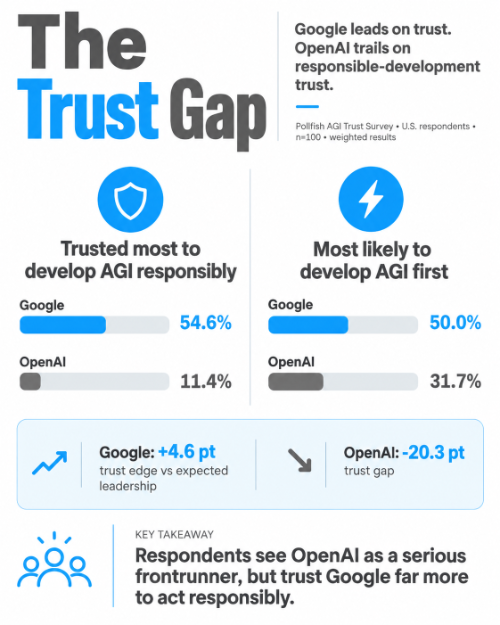
Google occupied a very different position. The company commanded 54.6% of responsible-development trust and was seen as most likely to reach AGI first by 50%-a rough alignment between perceived capability and trustworthiness. Google was the only company trusted by a majority of respondents and the only one where expectations about technical leadership matched confidence in ethical stewardship.
What accounts for this difference? The survey doesn’t probe motivations directly, but the contrast likely reflects perceptions shaped by corporate behavior, communication strategies, public controversies, and brand reputation accumulated over years. For OpenAI, rapid commercialization, leadership turmoil, and public debates about safety practices may have eroded trust even as the company’s technical achievements garnered attention.
Interestingly, 15.1% of respondents placed their highest trust in “another company”-outpacing both OpenAI and Anthropic. This group displayed unusually skeptical attitudes across the board: only 4.8% had meaningful confidence that leading companies would prioritize safety, and 86.1% wanted development slowed or stopped. Rather than championing a specific alternative, these respondents appear to be rejecting the current industry leaders entirely.
A Public Evenly Divided on Corporate Responsibility
When asked directly about confidence that leading AI companies would put public safety ahead of racing to develop AGI first, respondents split almost exactly down the middle. Combining those with “a great deal” or “a fair amount” of confidence yields 49.8%. Those with “not too much” or “none at all” total 50.2%.
This even split masks an asymmetry in intensity. Only 15.6% expressed “a great deal” of confidence, while a larger 20.2% expressed no confidence whatsoever. The distribution suggests slightly more concentrated skepticism than enthusiasm.
This divide shaped every other attitude measured in the survey. Among higher-confidence respondents, 53.1% still wanted stronger independent oversight, and only 16% supported unrestricted speed. But among lower-confidence respondents, the posture shifted dramatically: 71.7% wanted development slowed or stopped entirely. Every single person who selected “stop development entirely” came from the skeptical half of the sample.
The implications are clear. Without rebuilding trust, the AI industry faces growing pressure to slow down or face restrictions. Yet even among those with higher confidence, appetite for an unchecked race remains minimal. The data suggests that trust doesn’t enable acceleration-it merely shifts preferences from stopping development to continuing it under tighter supervision.
1. Problem
2. Cause
3. Solution
Problem
Public trust in AI companies is divided, with significant skepticism about prioritizing safety over competitive advantage in AGI development.
Cause
This is caused by perceived gaps between technological leadership and commitment to ethical governance, as well as insufficient external oversight mechanisms.
Solution
AI development must be coupled with transparent practices, shared safety standards, and independent oversight to restore public confidence and ensure responsible innovation.
Overwhelmingly Rejecting the Unrestricted Race
When presented with a scenario where one company appeared close to developing AGI, respondents were given four options. Only 12.4% chose “continue developing it as quickly as possible.” The remaining 87.6% wanted something different: 40.5% preferred slowing development until stronger safeguards are in place, 36.3% wanted continuation with stronger independent safety oversight, and 10.8% supported stopping development entirely.
This is one of the survey’s most decisive findings. Nearly nine in ten Americans want constraints on the AGI race. The preference isn’t for a particular constraint but for some constraint-whether oversight, delay, or prohibition.
Yet it’s equally important to note what respondents didn’t say. Only about one in ten wanted to stop AGI development outright. When answers are grouped by whether development should continue at all, the results are much closer: 48.6% favored continuing (either quickly or with oversight), while 51.4% preferred slowing or stopping.
The takeaway isn’t that the public opposes AGI. It’s that the public overwhelmingly opposes an unregulated winner-take-all race. Respondents want conditional development-innovation bounded by standards, oversight, and external checks. The mandate is for precaution, not prohibition.
Who Should Decide When AGI Is Safe?
The question of ultimate accountability produced no consensus. Government regulators, the developing company itself, and independent scientific experts each received approximately 29% support. An international regulatory organization garnered 12.7%.
Though the top three options were separated by barely more than a percentage point, the broader division is revealing: 70.5% assigned greatest responsibility to someone outside the company that built the system. Only 29.5% believed the developer should have final say.
This represents a clear rejection of pure self-regulation. Americans want an external check on release decisions, even if they can’t agree on what form that check should take. The relatively even split among government, scientists, and the company itself suggests ambivalence about centralized control. Respondents may prefer layered accountability rather than a single gatekeeper.
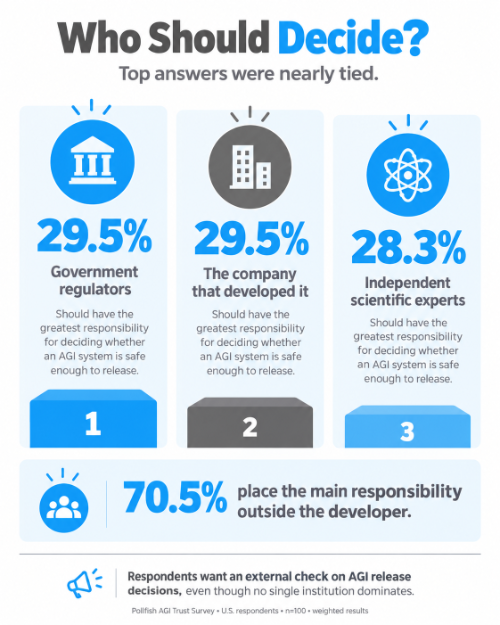
The least popular option was an international organization. This likely reflects skepticism about ceding control to global bureaucracies rather than opposition to international coordination per se. Domestic regulators or independent experts appear more palatable than supranational bodies.
Transparency as a Trust-Building Tool
One question tested whether disclosure of failure could rebuild trust. Respondents were asked if they would trust an AI company more or less if it publicly disclosed serious safety failures involving an advanced model. The results leaned positive: 47.9% said they would trust the company more, 31.1% said it would make no difference, and 21% would trust it less.
The Formula
Transparency
+
Independent Oversight
+
Shared Safety Standards
=
Public Trust
Effective AI governance requires openness, external checks, and common safety rules to build and sustain public confidence.
That’s a roughly 2.3-to-1 ratio favoring transparency. Altogether, 79% said disclosure would either increase trust or leave it unchanged. This suggests many respondents distinguished between the existence of a problem and a company’s willingness to admit it.
However, transparency doesn’t work equally across all groups. Among higher-confidence respondents, 63.3% said disclosure would increase trust. Among lower-confidence respondents, only 32.6% felt the same way. For skeptics, transparency may be necessary but insufficient. Disclosure can signal good faith, but it can’t substitute for structural safeguards or reverse a pattern of perceived recklessness.
Still, the finding offers actionable guidance: companies that openly share safety incidents are more likely to be rewarded than punished, at least among persuadable audiences. Transparency should be understood as one component of a broader trust strategy, not a cure-all.
Safety Vastly Outweighs Capability
When forced to choose between building the most capable AI system and building the safest and most controllable one, only 7.9% selected capability alone. Another 44.6% said both were equally important, and 42% chose safety alone. Combined, 86.6% of respondents placed safety on par with or above capability.
This finding helps explain the near-universal rejection of unrestricted speed. For most people, racing to develop AGI without prioritizing safety is incoherent-it achieves the wrong goal. Even those who value technological progress generally refuse to decouple it from control and safety.
The result also challenges a narrative sometimes promoted within the AI industry: that the public primarily wants cutting-edge capabilities and will tolerate risk to get them. The data flatly contradicts that assumption. Americans want advanced AI, but not at the expense of safety.
Competition Under Shared Safety Rules
The survey’s final question asked which competitive structure would inspire the most confidence. A clear majority-55.2%-chose “companies cooperating on shared safety standards while still competing.” This hybrid model beat every alternative by a wide margin. Another 20.2% preferred several companies competing closely, 11.2% wanted governments to coordinate development, 8.9% favored one company taking a clear lead, and just 4.4% supported an international organization managing AGI development.
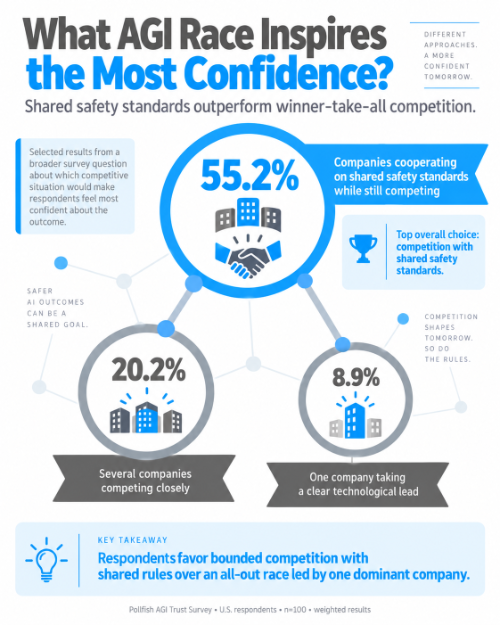
When combined, 70.8% of respondents favored some form of cooperative or coordinated structure, whether through shared company standards, government coordination, or international management. Only 29.2% preferred purely competitive arrangements.
The preferred model wasn’t centralization or nationalization. It was bounded competition: companies continue innovating and racing, but do so within a framework of shared minimum standards and mutual commitments. Respondents wanted dynamism with guardrails, not a government-run AGI program or a winner-take-all corporate free-for-all.
This preference aligns with responses to earlier questions. Taken together, the survey points toward a coherent governance vision: private innovation, external accountability, transparency, collective standards, and no single company serving as judge of its own safety.
Gender, Age, and Education Shape Attitudes
Demographic differences were pronounced, particularly by gender. Women were far more skeptical than men: only 38% of women expressed confidence that companies would prioritize safety, compared with 61.9% of men-a 23.9-point gap. Women were also more likely to prefer slowing or stopping development (58.2% versus 44.4%), to assign responsibility outside the developer (78.4% versus 62.4%), and to favor cooperative structures.
Yet even among men, support for an unrestricted race remained a minority position. Only 15.2% of male respondents wanted AGI developed as quickly as possible.
Age produced smaller but still notable differences. Younger respondents (18-34) were more likely to view OpenAI as the probable winner (39.2%) and to support rapid development (22.7%). But a majority of younger respondents-53.2%-still wanted development slowed or stopped. Older respondents were more likely to assign accountability outside the developer and to prefer coordinated development.
Education correlated with diverging company perceptions. Respondents with bachelor’s or postgraduate degrees were much more likely to expect OpenAI to develop AGI first (47.9% versus roughly 20-28% among those with less education), while those with high school education or less overwhelmingly trusted and expected Google (61.2% trust, 53.8% likelihood). The higher-education group was also substantially more likely to prioritize safety as the leading criterion and to reward transparency.
These patterns likely reflect overlapping factors-familiarity with the companies, media consumption, employment in tech sectors, and broader ideological orientations. The survey cannot disentangle these influences, but the differences suggest that messaging and policy strategies may need to be tailored to different audiences.
Our Perspective
Public trust in AI is in peril, as a majority of people see it as a greater risk than a benefit, pointing to the urgent need for ethical frameworks and transparency to regain confidence.
What the Data Demands
This survey lands at a moment when artificial intelligence is advancing faster than the institutions meant to govern it. The public message is unambiguous: trust is fragile, and the current trajectory is unacceptable. A slim majority doubts that leading companies will prioritize safety. Nearly nine in ten reject racing forward without stronger safeguards. Two-thirds want release decisions made outside the companies building the systems.
Yet the survey also shows that the door to public confidence remains open. Respondents didn’t demand an end to AGI research. They asked for shared standards, independent oversight, transparency, and a commitment to safety that matches the ambition to build powerful systems. Google’s ability to maintain both technological credibility and trust demonstrates that the two can coexist.
OpenAI’s legitimacy gap, by contrast, illustrates the cost of perceived recklessness. Technical leadership without corresponding trust is a brittle foundation. If a company reaches AGI first but lacks public confidence, it may face regulatory crackdowns, user backlash, or institutional resistance that slows deployment and adoption.
For policymakers, the data offers a mandate. The public wants action-not to stop innovation, but to shape it. Shared safety standards, external review of high-risk systems, mandatory disclosure of failures, and mechanisms that prevent any single company from self-certifying its own safety are all consistent with majority preferences.
For AI companies, the survey is both warning and opportunity. Transparency works, but only as part of a broader commitment to accountability. Racing to be first while neglecting safety will alienate the public, even among those inclined to support AI development. Cooperation on safety standards isn’t a concession to competitors-it’s a precondition for sustained public legitimacy.
The central finding is this: Americans are not opposed to AGI, but they are emphatically opposed to an unchecked race toward it. Trust has eroded to the point where the public is evenly divided on whether companies will do the right thing. Rebuilding that trust requires more than better communication. It requires structural change-oversight that works, standards that bind, and transparency that’s real. Without it, the AI industry risks not just public backlash, but the loss of its social license to build the future it envisions.
Sources
- unicri.org – Strengthening Public Trust in AI for Law Enforcement
- tandfonline.com – AI Ethics: Integrating Transparency, Fairness, and Privacy in Artificial Intelligence
- aign.global – What Strategies Can Be Developed to Increase Public Acceptance of AI through Effective Governance?
- sciencedirect.com – Public trust in AI: A dynamic social media view
- policyreview.info – Transparency in artificial intelligence
- publicpolicy.cornell.edu – What Americans Really Think About AI Algorithms
- tipcoautomatedsystems.ai – Building Public Trust in AI: How Government Agencies Can Enhance Service Delivery with Transparency and Ethics
- risk.lexisnexis.com – Build Trust in Artificial Intelligence AI with Transparent Procedures
- ibm.com – What Is AI Transparency?