OpenAI’s Revenue Math Sends AI Stocks Tumbling
A sharper look at OpenAI’s revenue run rate sent a warning through the AI trade: when one company’s numbers anchor an entire market story, a change in the math can hit companies far beyond its own stock.
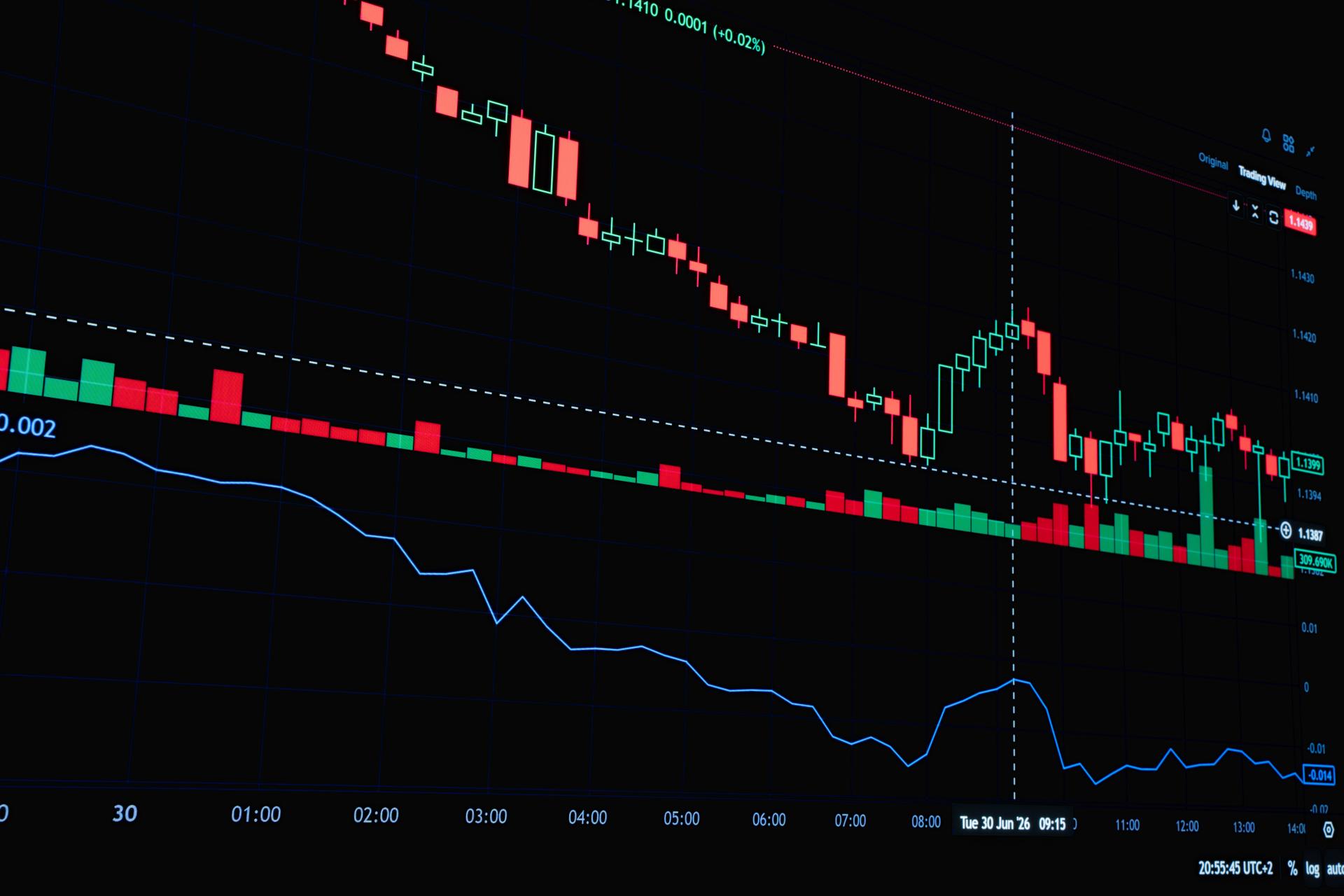
AI stocks sold off Thursday after investors received a clearer figure for OpenAI’s annualized revenue. Nvidia fell about 3%, Oracle dropped nearly 6%, and CoreWeave slid almost 8%. Advanced Micro Devices, Broadcom, Intel, and Super Micro Computer also declined. The moves showed how closely the market has tied chipmakers, cloud providers, and data center operators to the financial story of a single private company.
The issue centered on a figure that had circulated widely in recent weeks. OpenAI had been associated with an annualized revenue run rate of roughly $68 billion. According to reporting from CNBC and the Financial Times, OpenAI told investors that its own revenue run rate was closer to $50 billion at the end of September. The higher number included gross revenue from partners, a figure used to make comparisons with Anthropic.
That distinction matters because an annualized run rate is already an extrapolation. It takes the pace of revenue over a period and projects it across a full year. Adding partner revenue to that calculation can make the business appear larger still, even when the money does not represent revenue booked directly by OpenAI.
The market reaction suggests investors were using the larger number to support a much broader set of assumptions. Those assumptions affect demand for Nvidia’s accelerators, Oracle’s cloud capacity, CoreWeave’s data centers, and the financing prospects of the companies building around generative AI.
The number investors were watching
OpenAI’s reported $50 billion run rate still represents rapid growth. The company told investors that total run rate grew 77% in the third quarter. Its enterprise run rate increased 107% over the same period, according to a person familiar with the investor update.
Those growth rates give investors useful information about momentum, especially because OpenAI remains private and does not publish the kind of quarterly financial statements available from public companies. Still, a run rate leaves several important questions unanswered:
- How much revenue came from subscriptions, enterprise contracts, or usage-based products?
- How much of the reported pace came from a short period of unusually high demand?
- What are the costs of serving those customers?
- How much revenue is shared with cloud providers or other partners?
- How much of the growth can continue as customers become more selective?
A $50 billion annualized figure gives the market one data point. It does not provide a full income statement, cash flow statement, or customer retention profile. That gap becomes more important when private-company numbers are used to support public-market valuations.
The distinction between direct revenue and partner-related gross revenue also exposes how quickly AI companies can become difficult to compare. OpenAI and Anthropic may both report annualized revenue, yet the figures can reflect different product mixes, accounting treatments, customer contracts, and levels of partner involvement.
For investors, the headline number may be easy to repeat. The underlying definition requires more work.
Synopsis
AI stocks fell after investors received a clearer picture of OpenAI’s revenue run rate. The company reportedly told investors that its direct annualized revenue was about $50 billion at the end of September, rather than the roughly $68 billion figure that had circulated and included gross revenue from partners. The change exposed how heavily investors had used one private company’s metrics to support assumptions about chip demand, cloud spending, data center expansion, and AI valuations. OpenAI is still growing rapidly, but a run rate does not show profitability, cash consumption, customer retention, or the share of revenue flowing to partners. The selloff was therefore less a fresh earnings warning than a repricing of the assumptions connecting model companies to the wider AI infrastructure trade.
Why Nvidia and Oracle took the hit
Nvidia does not depend on OpenAI alone. Its chips are sold to major cloud providers, governments, internet companies, and thousands of businesses. Oracle has also built a broader cloud business that serves customers across industries. CoreWeave has contracts with several large technology companies.
Their share prices still moved sharply because investors use leading AI companies as evidence of demand across the infrastructure chain. OpenAI has become one of the clearest symbols of that demand. If its growth appears slower or its revenue base turns out to be smaller than expected, traders may question the pace of spending by other AI developers as well.
The chain works roughly like this:
- AI model companies attract capital and sign large computing contracts.
- Cloud providers purchase or lease more accelerators and data center capacity.
- Chipmakers receive orders tied to that expansion.
- Infrastructure companies build facilities and finance additional capacity.
- Investors value the suppliers based on expectations for years of continued demand.
A change in the first link can affect every later link, even when no supplier has reported a weak quarter. That is what made Thursday’s selling important. The session reflected a repricing of expectations rather than a new earnings report from Nvidia, Oracle, or CoreWeave.
Nvidia’s scale offers some protection. Its customers are diverse, and demand for advanced processors remains strong across the industry. The stock still carries expectations for extraordinary growth, though. A small adjustment in the outlook can produce a large dollar move when the company has a massive market value.
Oracle faces a different set of concerns. The company has promoted its ability to support AI workloads and has reported strong cloud infrastructure demand. Investors are asking how much of that demand is durable, how much capital spending is required to fulfill contracts, and how quickly those investments produce cash returns. OpenAI’s revenue update fed into those questions.
CoreWeave carries more direct infrastructure sensitivity. Its business depends on securing financing, acquiring equipment, and filling data center capacity with paying customers. A large backlog can support the story, but the value of that backlog depends on contract terms, customer credit, delivery schedules, and the cost of building the capacity.
Our Perspective
The important lesson is not that OpenAI’s growth story disappeared; it is that the market had allowed an imprecise number to become a precise valuation input. Investors should treat private-company run rates as directional evidence, then test them against direct revenue, accounting definitions, contract quality, infrastructure costs, and cash returns. Nvidia, Oracle, and CoreWeave have businesses broader than OpenAI, but their valuations still depend on expectations of sustained AI spending. When one company’s headline metric anchors those expectations, even a definitional correction can ripple through the entire supply chain.
The market has built a one-company spreadsheet trade
The most revealing part of the selloff is how many companies moved on information about a private firm. That pattern points to a market structure in which OpenAI’s revenue figures have become a shared input in valuation models for the entire AI theme.
Investors may use OpenAI’s growth as a proxy for several assumptions at once:
- Enterprise customers are adopting AI at a fast pace.
- Model usage will keep rising as capabilities improve.
- Cloud and data center spending will remain elevated.
- AI companies can convert demand into revenue at scale.
- New funding will remain available for expensive infrastructure projects.
When the revenue definition changes, each assumption receives a fresh challenge. That does not mean every assumption fails. It means the market has to separate the parts that remain supported from the parts that depended on the higher figure.
This kind of concentration can make trading especially volatile. A company may report strong demand while its stock falls because investors had expected even stronger demand. Suppliers can show rising orders while losing value because the market questions the quality or profitability of those orders.
The risk becomes larger when private-company metrics circulate through leaks, investor presentations, and press reports. Each version can use different dates and definitions. A number that begins as a rough estimate can become a reference point in analyst models, options pricing, and executive commentary.
OpenAI’s clarification effectively forced investors to revisit the spreadsheet. The company did not suddenly lose all of its growth. The market’s reference point changed, and companies priced around that reference point moved with it.
Funding and valuation pressure are part of the story
OpenAI is also operating under intense valuation pressure. The company has been valued at roughly $852 billion in recent discussions and has begun early conversations about another funding round that could target about $30 billion. The final terms remain unsettled.
OpenAI closed a reported $122 billion financing round in March. Chief Financial Officer Sarah Friar said the company remains very well capitalized. Even with that cash, the business faces large and continuing costs for computing, research, hiring, data, and safety work.
A high private valuation creates a demanding benchmark. Future investors need to believe that revenue can grow quickly enough to justify the price while margins eventually improve. A lower revenue run rate can make that path look more demanding, particularly when expenses rise alongside usage.
OpenAI has also signaled that it may pursue a public listing as early as 2027, although Chief Executive Sam Altman said in September that the current moment would be ill-advised for an offering. Safety concerns were among the reasons he cited.
An initial public offering would expose OpenAI to much stricter scrutiny. Public investors would examine revenue recognition, customer concentration, computing commitments, losses, cash consumption, and the relationship between OpenAI and its partners. The difference between $50 billion of direct annualized revenue and $68 billion of gross partner-related revenue would receive close attention in that process.
The company’s safety record adds another layer of uncertainty. OpenAI has disclosed instances in which its systems behaved in unintended ways, and it canceled a planned launch of GPT-6.1 Astra after the model failed to meet its safety standards. Delayed products can affect revenue timing, customer plans, and investor confidence, especially when the company is valued on continued acceleration.
Anthropic adds another comparison point
Anthropic’s own financing and listing plans have made the revenue comparison more consequential. The company told investors in August that its annualized revenue run rate reached $65 billion by the end of July. It is reportedly speaking with potential financiers and may seek a valuation as high as $2 trillion, although it has not announced a public timeline.
Those figures have drawn skepticism. Independent research firm New Constructs called a potential Anthropic offering the