Google’s AI Summary Is the First Thing 28% Always Read, Search Research Reveals
Google’s AI summaries are becoming a regular first stop for searchers, but the same users still want links, evidence, and human-written detail when a decision matters.
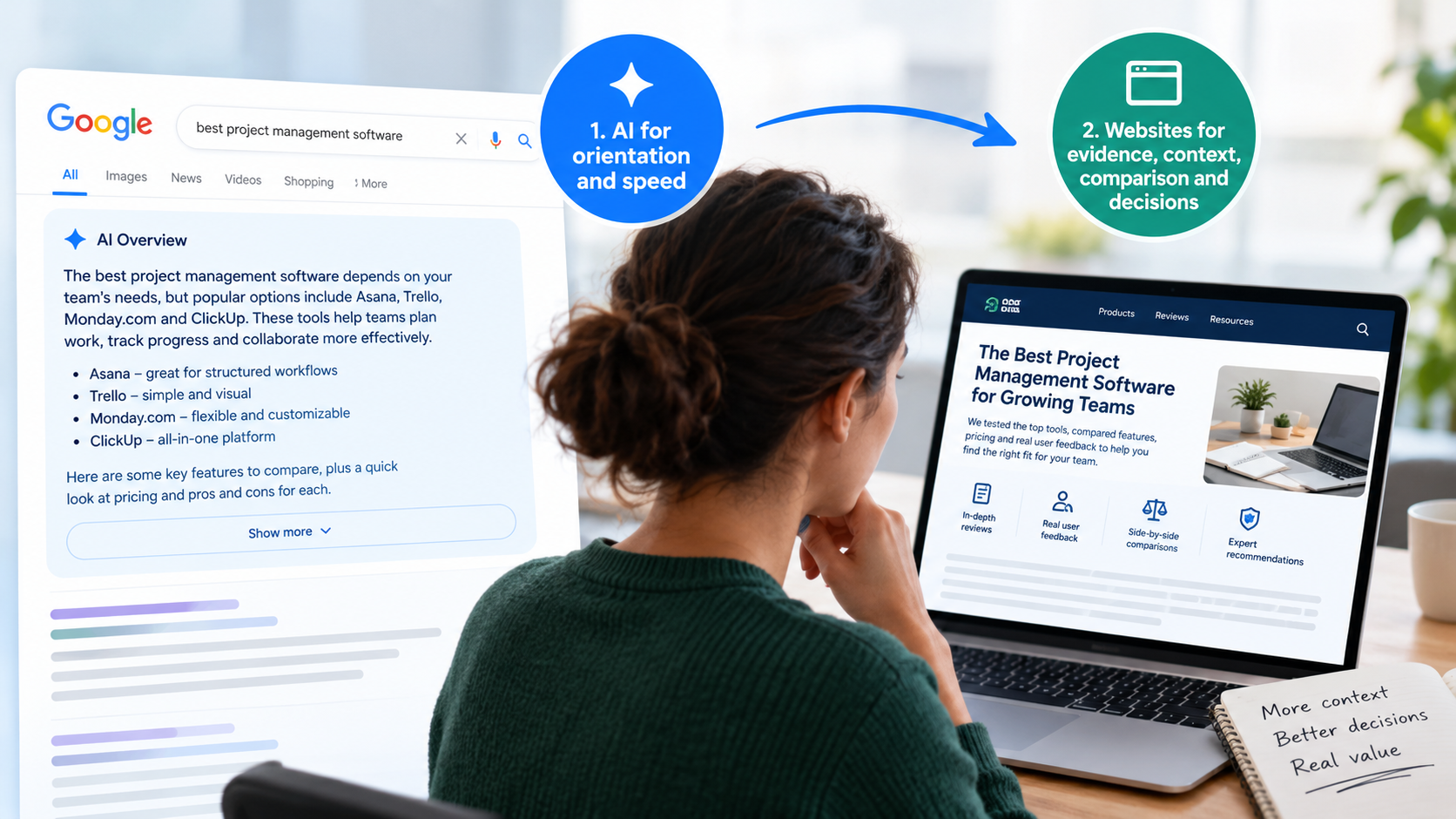
A September 2026 ContentEngine survey of 100 U.S. respondents shows how search behavior is settling into a two-step routine. People often scan an AI-generated answer for speed, then decide whether a traditional result can provide the detail or confidence that the summary leaves out. The pattern gives search marketers a more useful picture than the idea that AI summaries simply replace website visits.
The headline uses a 28% figure for people who always read Google’s AI summary first. In the survey’s detailed raw breakdown, 26% selected that response. The practical takeaway is consistent across both figures: about one in four respondents treats the summary as the first search element they examine. A wider 65% say they always or frequently read the summary before looking at traditional links.
AI summaries win the first look
The survey asked respondents what they do when a Google AI-generated summary appears above conventional search results. Twenty-six percent said the summary is the first thing they look at. Another 39% use it to decide whether they need to scroll down to the links. Combined, those groups account for 65% of the sample. A stratified estimate puts the figure at 65.9%.
That first look matters because it changes the job performed by the search results page. The user may form an initial answer before seeing a publisher’s headline, product page, service page, or research article. A website now has to earn attention after the summary has already framed the topic.
The behavior also shows why a high rate of summary reading does not automatically equal a high rate of website avoidance. Respondents gave several different answers when asked whether an AI Overview removes the need to visit a website:
- 24% said this happens very often, especially for simple facts.
- 44% said they get the gist from AI but still click for details.
- 21% said summaries rarely provide enough information and that they almost always click to verify.
- 11% said they never trust the summary enough to stop searching.
The largest group, at 44%, describes the searcher’s new decision point. The summary handles orientation. The website handles the work that follows: checking a claim, comparing options, understanding exceptions, reading evidence, or applying information to a specific situation.
Synopsis
Google’s AI summaries are becoming a common first stop, with roughly one in four survey respondents saying they always look at the summary first and 65% saying they always or frequently read it before traditional results. Yet the survey points to a two-step search habit rather than a complete shift away from websites: users often rely on AI for orientation and speed, then visit human-written pages for evidence, context, comparison, and decisions. For marketers, the opportunity is to create content that is easy for AI systems to understand while offering enough original value and trust signals to justify a visit.
Search behavior is splitting into speed and depth
A short AI response can answer a basic question quickly. It can define a term, list several options, summarize a position, or point to a likely next step. A page written for people can carry the supporting detail that a compressed answer cannot fit comfortably.
That division creates a two-step search habit:
- The searcher scans a machine-generated summary to decide whether the topic is relevant and whether the initial answer seems plausible.
- The searcher visits a source when the task requires proof, context, instructions, comparison, or a decision.
This pattern gives human-written pages a different role in search. A page may receive a visit from someone who already knows the basic answer and wants the part that affects their situation. That visitor may be more selective, but their visit can also carry stronger intent.
The survey does not measure actual click-through rates or traffic records. It records how respondents describe their behavior. That distinction matters because people can remember their search habits differently from the way they act in a browser. Still, the responses clearly show that many users see summaries and websites as connected parts of the same search process.
Trust sits in the middle of the search experience
Trust in AI responses remains conditional. Forty percent of respondents trust AI-generated search responses about as much as a standard website. That is the largest single response group, but it represents parity rather than strong confidence.
The remaining responses lean in both directions:
- 35% expressed skepticism or no trust.
- 25% said they trust AI responses more than standard websites or trust them completely.
- Stratified estimates put skepticism at 34.5% and higher or complete trust at 29.0%.
The cross-tabulation is especially useful. Among the 25 respondents who expressed higher or complete trust, 24, or 96%, always or frequently read AI summaries first. Among the 35 skeptical respondents, 11, or 31.4%, still read summaries regularly.
That result captures a common practical tradeoff. A searcher can doubt the accuracy of an AI response and still use it because it saves time. Reading a summary does not require full confidence in every sentence. It can serve as a quick filter before a person decides whether further checking is worthwhile.
For publishers and brands, this leaves room for content that earns trust after the first glance. Clear sourcing, named authors, visible dates, transparent methods, original research, and specific evidence give a page reasons to be opened and believed. A summary may introduce the topic, while the source establishes whether the information deserves action.
Our Perspective
The most useful interpretation is not that AI summaries are replacing search traffic, but that they are changing what a valuable visit looks like. A page that merely repeats a basic answer is increasingly vulnerable to being bypassed, while a page that documents its claims, explains tradeoffs, applies information to a real situation, or offers original evidence can become more important after the summary. Marketers should optimize for the handoff from machine-generated orientation to human-supported action rather than treating visibility and clicks as interchangeable outcomes.
External research shows a real click risk
The ContentEngine findings sit alongside research that records more cautious user behavior. A Pew Research Center analysis used browsing data from 900 U.S. adults and found that Google users were less likely to click result links when an AI summary appeared on the page.
A separate arXiv study examining a month of browsing data from a representative panel reported that clicks to sources cited in AI Overviews occurred in about 1% of AI Overview visits. That figure describes a specific type of source click and should not be treated as a universal measure of all website traffic from AI-enhanced search.
These findings and the ContentEngine survey measure different things. Browsing data captures observed behavior. The survey captures stated habits and attitudes. The former can reveal whether a click happened; the latter can explain why a person says they read a summary and what they expect from the search experience.
Google has presented a more favorable interpretation in its own discussion of AI Mode, saying average click quality has increased and that AI Overviews are sending slightly more quality clicks to websites. Google defines quality clicks as visits where users do not quickly return to the results page. That measure focuses on engagement after a click, while Pew and the arXiv research focus on whether clicks occur in the first place.
For marketers, the safest reading is operational: AI summaries can reduce some clicks, change which pages receive attention, and send more qualified visitors to other pages. Traffic reports need to show the full pattern instead of relying on total clicks alone.
Chatbots are joining research without taking over
The survey also examined complex research and found that chatbots have entered the mainstream workflow. Sixty-nine percent of respondents use tools such as ChatGPT, Gemini, or Perplexity for at least some research. The stratified estimate rises to 72.1%.
Usage intensity tells a more precise story:
- 9% make an AI chatbot their primary research starting point.
- 40% use traditional search and AI chatbots equally.
- 20% primarily use Google but sometimes check an AI chatbot.
- 31% rely exclusively on traditional search-engine results.
The 60% who use search and chatbots in a mixed way represent the dominant pattern among people who use both channels. A chatbot may help a searcher break down a complicated subject, generate follow-up questions, compare explanations, or organize information. Traditional search may then supply current documents, original sources, product details, local information, or pages the chatbot did not surface.
A 69% chatbot-use figure therefore describes adoption, not replacement. The survey does not identify which platforms respondents use most, which research topics trigger chatbot use, or whether the answers satisfy them. Traditional search remains important because it offers a visible set of sources and a path to information that users can inspect directly.
The Reuters Institute’s 2026 report on generative AI and news also describes AI systems moving from standalone tools toward information infrastructure. That shift makes source visibility more complicated. A brand can be discovered through a search result, mentioned in a chatbot response, summarized in an AI Overview, or encountered through a human-authored page that a user already trusts.
Key Takeaways
- AI summaries win the first glance — About 65% of respondents always or frequently read an AI summary before traditional links.
- Summaries do not eliminate website visits — Most users still visit pages for evidence, context, comparisons, and decision support.
- Trust remains conditional — People may use an AI answer for speed even when they remain skeptical of its accuracy.
- Human-written content still matters — Half of respondents prefer AI summaries paired with prominent links to human-authored articles.
- Search marketing must measure the full journey — Visibility, qualified clicks, branded searches, engagement, and conversions all matter alongside raw traffic.
Longer queries are creating more specific search opportunities
Forty-two percent of respondents say their typical search queries have become longer during the past 18 months. Nineteen percent report significantly longer queries, including full sentences and questions. Another 23% now use three or four words where they previously used one or two.
Forty-five percent report no change, and 13% say their queries have become shorter. The stratified estimate puts the longer-query share at 49.0%, which points to a substantial shift without establishing a universal move toward conversational search.
Users who have adopted longer queries also report stronger satisfaction with five-word-or-longer searches. Among the 42 respondents whose queries became longer, 34, or 81%, gave a positive satisfaction response. Among respondents whose query length stayed the same or became shorter, 34 of 58, or 58.6%, gave a positive response.
When asked directly about longer, more specific searches, 68% said they were either much more satisfied or somewhat satisfied. The stratified estimate was 70.9%. Only 6% reported dissatisfaction because extra words seemed to confuse the search engine.
The survey’s response about keywords and conversational questions adds an important qualification. Forty-seven percent said effectiveness depends entirely on the topic’s complexity. Twenty-eight percent favored conversational questions, and 25% favored specific keywords.
That result supports a broad query strategy. A page can target a concise phrase such as “best accounting software for contractors” and also address the natural-language version, such as “Which accounting software works best for a small contracting business with several employees?” Searchers use both forms, and the topic determines which form is most useful.
Users still want links to human-written content
The strongest signal in the survey concerns the future people say they want. Half of respondents prefer a hybrid search experience that provides an AI summary while prioritizing links to human-written articles. The stratified estimate raises that preference to 55.6%.
Other respondents selected the following options:
- 26% prefer a simple website directory without AI interference.
- 15% want a personal assistant that can take actions such as booking a flight.
- 9% want a computer to provide one perfect answer.
The hybrid and website-directory choices together account for 76% of the raw sample, or 77.9% in the stratified estimate. Both options preserve a direct path to websites and human-created material, even though one includes an AI summary and the other favors a directory experience.
Frequent AI-summary readers show the same preference. Among the 65 respondents who always or frequently read summaries first, 42, or 64.6%, prefer the hybrid option with links to human-written articles. Among the 35 who rarely or never read summaries first, only 8, or 22.9%, choose that option.
The result gives marketers a practical target. Content needs to work as a source for a short summary and as a destination for a person who wants more than the summary can provide. A page that gives away a basic fact may still attract a visit when it adds a calculation, example, original finding, decision guide, or clear explanation of tradeoffs.
The Formula
Clear answers
+
Credible evidence
+
Decision value
=
Qualified engagement
- Content that is easy for AI to summarize and valuable for people to explore earns attention beyond the first search glance.
Demographics show several search habits developing at once
Age differences in the survey complicate simple assumptions about who is driving AI adoption. Among respondents aged 18 to 34, 56.7% report longer queries. The figure falls to 34.0% among those aged 35 to 54 and reaches 39.1% among those aged 55 to 62.
The youngest group has the highest preference for the hybrid future, at 63.3%. The oldest group has the highest preference for a website directory without AI, at 39.1%. Chatbot use does not follow a simple age decline, though. Seventy-three point nine percent of the oldest group report at least occasional chatbot use for complex research, compared with 57.4% of the middle age group.
Gender differences are modest for most measures. Frequent AI-summary reading is reported by 64.3% of women and 65.9% of men. Higher or complete trust is reported by 19.6% of women and 31.8% of men, a difference that requires more research before it can support a broader claim.
The sample has important limits. It includes 100 U.S. respondents, ages 18 to 62, with 53% from the South. The source does not document the recruitment process, sampling frame, or weighting method in enough detail to support population-wide conclusions. The survey also measures self-reported views at one point in time and includes questions that combine several ideas, such as summaries, links, and human authorship.
Those limits set the proper use of the findings. The survey can help marketers form working hypotheses about search behavior. Search logs, controlled experiments, larger representative samples, and repeated surveys would be needed to establish broader trends and causal effects.
The search result is becoming a handoff
The survey describes a search journey in which each layer has a distinct job. The AI summary helps a person orient quickly. The conventional result provides a route to a source. The human-written page supplies depth, proof, and context for choices that carry consequences.
This handoff explains why AI adoption and continued demand for websites can grow at the same time. People can value fast synthesis and still want control over the underlying material. They can use a chatbot for an early explanation and open a source before relying on the answer. They can read a summary first and still prefer a future where links to human-authored work remain prominent.
For digital marketers, the practical challenge is specific. Content needs enough structure and clarity to be understood by AI systems, enough authority to be trusted by cautious readers, and enough substance to justify a visit after the summary has done its quick work.
The search habits described by the survey point toward a web shaped by collaboration between machine summaries and human sources. The summary may win the first glance. The page that explains, documents, and helps a person decide can still win the moment that matters.
Frequently Asked Questions
How often did U.S. respondents read Google’s AI summaries before traditional search links in the September 2026 ContentEngine survey?
Do Google AI Overviews eliminate the need for U.S. searchers to visit websites?
How much did U.S. respondents trust AI-generated search responses compared with standard websites?
What evidence shows that Google AI summaries can reduce clicks to websites?
How are ChatGPT, Gemini, and Perplexity being used for complex research?
How have U.S. search query lengths and satisfaction changed during the past 18 months?
What kind of search experience did U.S. respondents prefer for the future?
What should search marketers do when Google AI summaries appear above traditional results?
How representative are the findings from the September 2026 ContentEngine survey?
Sources
- contentengine.pro – Survey: The Impact of AI Responses on Search Behavior and Satisfaction
- Pew Research Center – Do people click on links in Google AI summaries?
- Reuters Institute for the Study of Journalism – Generative AI and News Report 2026: From standalone tools to information infrastructure
- Google – How AI Mode is changing and expanding the way people search
- arXiv – Investigating Click Behaviors On Google Search Result Pages That Produce an AI Overview